


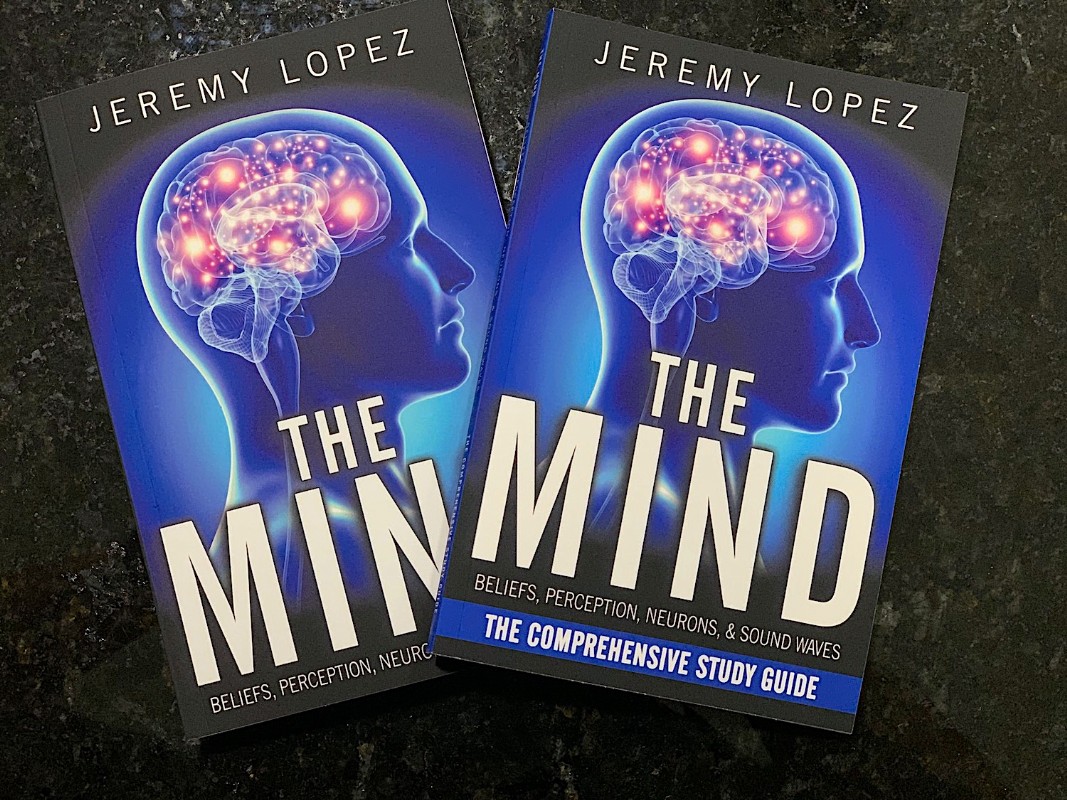
 The Mind Combo
Ebook/E-Study Guide
By Jeremy Lopez
Price: $31.99
"A healed mind does not race. It responds.”
There is a particular quality of thinking that most people have experienced at least once, usually by accident.
It arrives in the middle of a walk, or just after waking, or in the stillness following a conversation that went deeper than expected. It is not loud. It does not announce itself. It simply appears, and when it does, it has a quality that is unmistakable.
it is clear, specific, unhurried, and exactly on point for the moment.
This is not an altered state. It is not a spiritual achievement reserved for monks and mystics. It is what the mind naturally is when it has been freed from the weight of what it was never designed to carry.
What the Mind was Carrying
For most of us, the mind has spent years functioning as a security system, a forecasting department, an identity management office, and an emergency response team, all running simultaneously.
It has been rehearsing conversations that have not happened yet. It has been replaying conversations that already did. It has been scanning for threats, managing impressions, bracing for disappointment, and constructing arguments to protect us from vulnerability.
This is exhausting work and it is not what the mind was designed for.
When we returned to the heart in March, when we allowed the body to speak and awareness to open, we began to relieve the mind of responsibilities it had taken on by default because no one else seemed to be home. The heart reclaimed its role as the center. The body reclaimed its voice. Awareness created space and slowly, the mind began to exhale.
Responsive Rather Than Reactive
I spent years watching athletes whose minds were reactive. A bad call from the umpire would trigger a cascade of thoughts that had nothing to do with the next point. A missed shot would instantly produce a story about what it meant, what it confirmed, and what was now in danger.
The mind was not responding to what had happened. It was reacting to what it feared it meant.
Transformative thinking is not faster or more disciplined thinking. It is thinking that has become responsive rather than reactive. It engages with what is actually present rather than with the story it has already prepared. It does not need to rehearse the future or “re-litigate” the past because it trusts, at a level below thought, that the present moment is enough to work with.
This is what I saw in the players who were genuinely in The Zone Space.
Not blankness. Not the absence of thought. But thought that was precisely fitted to the moment, no more, no less, and then allowed to be released.
Clear Rather than Compulsive
One of the most telling signs of fear-sourced thinking is compulsiveness. The same thought appears again and again, wearing slightly different clothes. The mind returns to the same worry, the same question, the same unresolved loop, as though repetition might eventually produce the answer.
It does not.
Repetition produces more repetition.
Heart-sourced thinking is clear rather than compulsive. It does not need to return to the same place repeatedly because it actually arrives somewhere. A thought lands, is received, is acted upon or consciously set aside, and the mind moves on. There is a natural economy to it and an absence of waste.
In Holding on Loosely I wrote about living with a secure identity and a quiet mind.
Timely Rather Than Anticipatory
Perhaps the most liberating quality of transformative thinking is that it arrives when it is needed rather than long before, frantically trying to prepare for every possibility. The anticipatory mind is always living several steps ahead of the present, which means it is never quite here.
The responsive mind is here and because it is here, it can actually see what the moment truly requires.
I notice this in my own life most clearly in my practice of Tai Chi. The form requires a quality of attention that is precisely present. You cannot be two moves ahead and execute the movement you are in.
The mind must be exactly where the body is. That synchronization, body and mind arriving together in the same moment, is a physical experience of what transformative thinking feels like in daily life.
Pablo Giacopelli

 Visitor Comments (0)